
Most beginners pick an affiliate program by sorting for the highest commission and joining the first one near the top. That produces a program you can’t explain to anyone and a site with no clear reader. A better starting point is a specific person with a specific problem, because the program’s job is to supply the solution you recommend to that person.
Start with your reader’s problem, not the commission rate
Write one sentence describing the person you want to help and what they are stuck on. “Someone starting a food blog who doesn’t know how to get their first visitors” is a usable sentence. “People who want to make money online” is too wide to test a program against.

Once you have that sentence, every program becomes easier to judge. You are no longer asking whether it is good. You are asking whether it solves the problem in your sentence. A program with a generous payout for a product your reader would never buy earns you nothing, and a modest payout on something your reader needs and searches for earns you something.
If the sentence is hard to write, the niche may still be too loose. Narrowing it first will make the program decision much shorter, and the ten best niche ideas for Wealthy Affiliate is a reasonable place to look for a direction that has room for specific problems.
The five questions that cut a long list down to two
Run each program on your long list through the same five questions. The order matters, because the first question removes the most options and the last removes the ones that look fine until you read the fine print.
- Does it fit my reader’s problem? The product should answer the problem in your sentence directly, not loosely.
- How is the commission paid? One-time, recurring and tiered structures reward different kinds of sites.
- How long does the cookie last? This decides whether a sale that happens a few days after the click still pays you.
- Can I use the product myself? Firsthand use is what makes your recommendation specific and honest.
- What do the program’s rules allow? Some terms restrict how you can promote, where you can send traffic and when you get paid.
Give each program a pass, a maybe or a fail on each question. Anything with a fail on question one or question four comes off the list immediately. Programs that fail on question five need a closer read, since a restriction can be minor or can rule out your whole plan. Most lists shrink to two or three programs after this pass, and the final comparison later in this article handles the rest.
Commission structures explained: one-time, recurring and tiered
The headline percentage tells you very little until you know how the commission is structured. Three structures cover most programs.

One-time commissions
You are paid once for each sale or sign-up. This suits products people buy once, such as a physical item, a course or a piece of software with a single purchase price. Income from this structure depends on a steady flow of new buyers, so the program needs a product your audience wants repeatedly and a site that keeps attracting new readers.
Recurring commissions
You are paid again each time the customer renews, usually monthly or yearly, for as long as they stay subscribed. This suits subscription software and memberships. A single recommendation can keep paying, but the payout depends on the customer staying, so a product with high cancellation rates pays less over time than the rules suggest. Check whether the recurring payment lasts for the customer’s whole subscription or stops after a set period.
Tiered commissions
Your rate changes with performance, often rising once you pass a certain number of sales in a period. Tiers are a fair reward for growth, but a beginner should look at the lowest tier, since that is the rate you will earn at the start. A program that advertises its top tier prominently and buries the entry rate deserves a second look.
None of these structures is better in every case. A one-time commission on a product your reader urgently needs can outperform a recurring one on a product they only half want. Match the structure to how your reader buys.
Cookie length, payout thresholds and the terms nobody reads until later
The cookie is a small file stored in a visitor’s browser when they click your link. If they buy while the cookie is still active, the sale is credited to you. A short cookie means that a reader who clicks today, thinks it over for a week and buys later may not count. For products with a considered purchase, such as software or anything expensive, a longer cookie is a real advantage. For an impulse purchase, a short one costs you very little.
Look for these terms in the program’s own documentation before you join, not after your first sale:
- Payout threshold. Many programs only pay once your balance reaches a minimum. A high minimum means a small site may wait a long time for its first payment.
- Payment schedule. Find out whether payments are monthly, how long after the month ends they arrive, and which payment methods are available in your country.
- Refund and chargeback handling. Commissions on sales that are later reversed are usually taken back. Read how long that window lasts.
- Attribution rules. Some programs credit the last click, and others credit the first. This affects whether you get paid when a reader clicks several affiliates’ links.
- Where the program pays. Confirm that your country is supported for sign-up and payment.
None of this is exciting reading, but each item is a place where two programs with the same percentage pay very differently.
Why you should be able to use the product yourself before you promote it
A recommendation is worth more when it comes from someone who has used the thing. You can describe how the setup works, where it confused you, what it does well and who would not benefit. Readers notice the difference between that and a rewritten sales page, and search engines increasingly favor content that shows real experience.
Before you commit, check whether you can actually get hands-on access. A free plan, a trial, a low-cost entry tier or a money-back period can all work. If the only way to try the product is a large purchase, factor that into the decision honestly. Some products are hard to try for good reasons, and in those cases you can still be truthful by saying clearly what you have and have not used.
Using the product also protects you. You find out whether the product does what the sales page says before your readers do, and a product that disappoints you is one you should not recommend. Your credibility with your reader is worth more than any single commission.
Red flags that should take a program off your shortlist
Some warning signs are strong enough to drop a program without further analysis:
- Income promises instead of product detail. If the program’s pitch to affiliates talks mainly about how much you could earn and little about what the product does for customers, the product may not be strong enough to sell on its own.
- Commissions that depend on recruiting. Programs that pay mainly for signing up other affiliates, rather than for selling to real customers, are built around recruitment rather than the product.
- Vague or missing terms. If you cannot find the commission rate, cookie length and payout rules in writing, you cannot plan around them.
- No clear way to contact the program. A real program has a support address, a help page or an affiliate manager. If you can’t find one, you won’t get an answer when a commission goes missing.
- Terms that can change without notice. Many programs reserve the right to change their rates, and that is normal. A program that offers no notice and no explanation when it does is a risk for anything you build around it.
- A product that has no reviews, no history or no visible company behind it. You are putting your name next to it.
One red flag does not always mean you should walk away, but two or more should.
Comparing your final two programs side by side
When two programs survive the five questions, put them in one table and fill in every row with facts from each program’s own pages. Do not fill it in from memory.
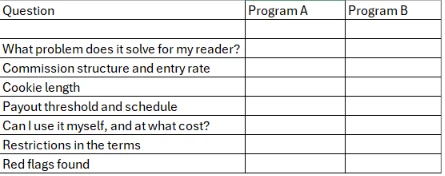
Fill each cell with a short factual note and then mark which program wins that row. The row with the most weight is the first one, because a program that fits your reader’s problem better should win a close contest even if it loses on commission rate. Count the other rows as tie-breakers.
If the result is still even, choose the one you can try first. Firsthand experience will tell you more in a few days than another round of reading, and joining a program rarely stops you from adding a second later. The decision is more reversible than it feels while you are stuck on it.
What to do in your first week after you join
Joining is the start of the work, and a few early tasks make the rest easier.
- Read the full terms again. Now that you have an account, look for rules that were not visible before sign-up, and note anything about how you may use the brand name and links.
- Set up your payment details. Entering them early shows whether your country and payment method work, before you have earnings waiting.
- Use the product. Go through the setup yourself and write down what you notice, including the confusing parts. These notes become the raw material for your first honest article.
- Add a disclosure to your site. Readers should know when you earn from a link, and in many places the rules require it. A dedicated page works well, like the affiliate disclosure on this site.
- Plan your first piece of content around the reader’s problem. Return to the sentence you wrote at the start and write an article that helps that person, with the product as part of the answer.
- Find your tracking. Locate the reports in your affiliate dashboard so you know where clicks and sales appear.
After a week you will know whether the program behaves the way its pages said it would, and you will have a first draft of real experience to share with your readers.
Read the member’s review of the Wealthy Affiliate program to see how one program measures up against these five questions.